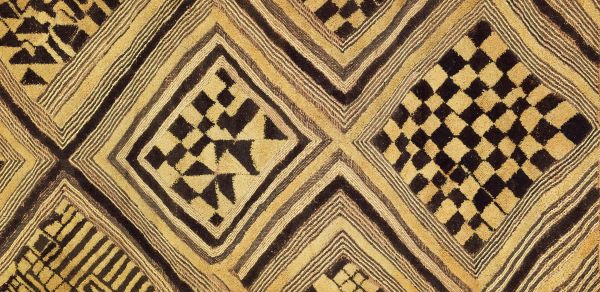
As part of a series of 2025 programs revisiting groundbreaking exhibitions and publications from The Textile Museum’s 100-year history, guest curator Vanessa Drake Moraga looks back at Weaving Abstraction: Kuba Textiles and the Woven Art of Central Africa. The 2011 exhibition was notable not only as the first major presentation of African textiles at The Textile Museum since founder George Hewitt Myers acquired a rare Kuba skirt in 1933. It was also the first comprehensive museum exhibition and catalog in the United States to explore the breadth of the distinctive Kuba tradition, which represents one of the most complex, historically intact and artistically innovative textile cultures in Central Africa.
The exhibition highlighted the extraordinary creativity and scope of Kuba textile design, which is renowned for its ingenious pattern aesthetic executed with textural surface techniques (cut-pile embroidery, appliqué) that were developed for prestige cloth, as well as ceremonial and funerary attire.
As the title suggests, Weaving Abstraction connected the Kuba tradition to a larger regional context of Congolese fiber art and weaving, including several coastal Kongo textiles also acquired by Myers that provided a rare historical perspective. Drake Moraga will discuss exhibitions and research since 2011 that have amplified our knowledge of Kuba and Kongo textile history and dating — and touch upon the growing recognition of Kuba influence in global design and fashion from early modernism to the contemporary moment.