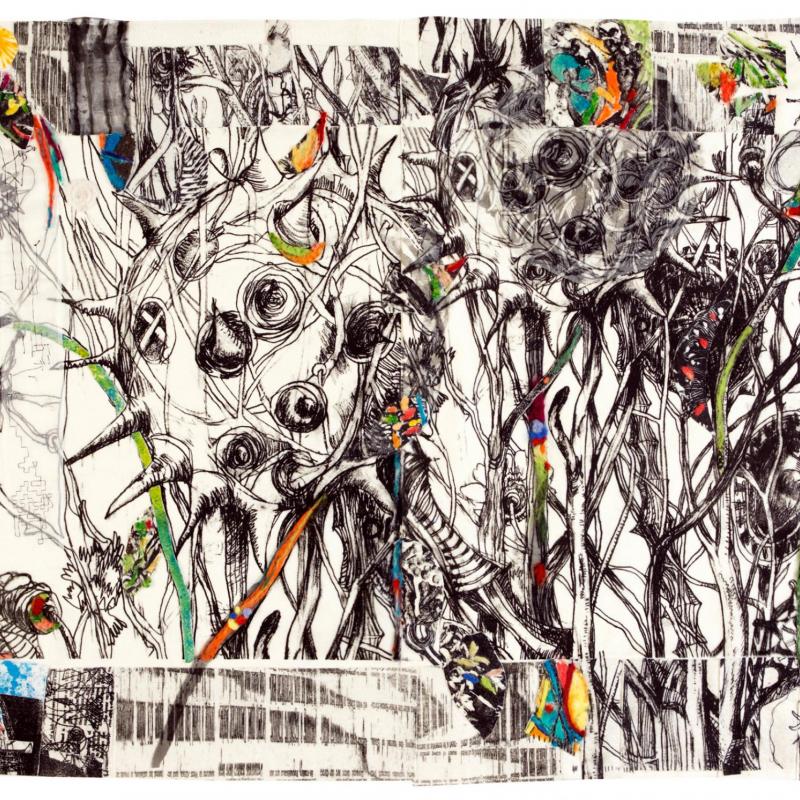
This article was included in the SAQA Global Exhibition sustainABILITY catalog.
View in PDF format
In John Carpenter’s1988 film, They Live, the main character viewed the cult, iconic images of a stark, greyscale landscape peppered with billboard slogans of “CONSUME,” “OBEY,” “CONFORM,” from behind a pair of sunglasses. At the time, it was a commentary on the commercialization and consumerism habits of the 1980s. Today, those cult film images are more relevant than ever in the fast paced and ever evolving world of fashion and its symbiotic relationship with consumer cultures. “Fast fashion” for all its trappings, multi-faceted layers, and subjective damage, is a difficult entity to unpack.
Historically born from the need for mass market and high street companies to evolve, expand, and survive, these business entities saw an opportunity in the growth of youth interest in style, trend, and fashion. Pop culture and musical influences were everywhere, and gazing at the bright music videos, with their lush colors and vibrant outfits, only opened the doors for the need to shop. Whether it was students (like myself ) recreating some version of what trotted down the latest catwalks in cheaply acquired, end-of-roll, or reclaimed fabrics, or youths copying pop idols’ styles through thrift finds and customized hand-me-downs, at some point in the early to mid-nineties, there was a gap in the market for what was affordable and readily accessible to the mainstream.
Style tribes had evolved, from the grunge aesthetic trend of the early part of the 1990s, to more fractured styles. Suddenly you could be a mix of goth girl, sporty jock, and cool nerd all at once, and everything could be purchased from the same place for a reasonable price. Toward the latter part of the 1990s, there was suddenly access to affordable clothing that bore some similarity in style to the inspirational catwalk and editorial imagery seen in the magazines I loved to scour. Despite the lack of quality fabrication and construction of the ready-to-wear brand pieces I aspired towards, but could definitely not afford, there was a certain appeal to my generation.
Fast forward almost 25 years later, and we are living in very different times. In the context of the now, people are more conscious of green, environmental, and ethical issues. One could argue that the fast fashion industry was, and still is, a huge cause for concern in all three of those areas.
Documentaries such as the powerful The True Cost (2015) opened more eyes to the damage, pollution, and waste of the fashion industry. It also made people aware of harrowing and tragic events such as the collapse of the Darkha factory in Bangladesh, and the plight of laborers forced to work in appalling conditions just so that the public could buy a cotton t-shirt for a few dollars.
But how many of us look at our clothing labels to even see the washing instructions, let alone where the garments are made? Though we may check the ingredients in our foodstuffs or our beauty products, do we do the same with what we wear? The main problem with the fast fashion industry is, quite simply, us.
“Educating for this kind of deep transformation means centering a diversity of design world views, histories and practices that have primarily existed and continue to exist outside of the dominant capitalist fashion model. It means developing new fashion and textile practices that honor interdependence with each [practice] and the Land. And it also means working with students to question and reimagine how we place value on design and craft practices and how we can shift wearers’ perspectives about them.”
— Dr. Ben Barry, PhD (2022) Dean of the School of Fashion, Parsons, The New School.
We are constantly surrounded by marketing, whether in the visual maelstrom of Times Square, Piccadilly Circus, or Shibuya Crossing. When we open up our cell phones to check emails during our commutes to work, we’re bombarded by pop-ups. Advertisements for products that we don’t even know we want or need are impossible to get away from, no matter how hard we try. From infamous Black Friday door buster sales, to the glamorization of commercial consumerism on shows like Sex & the City and Confessions of a Shopaholic, we watch with slack-jawed awe for the former and admire the latter. The sight of celebrity actors and actresses wearing desirable, covetable looks while living their best lives generates a need to consume and emulate. Surely If there was no demand, there would be no need for supply.
If fast fashion companies weren’t given the opportunity to expand product ranges upon ranges, stores upon stores, in location upon location, would consumption be affected? Would we want to travel further distances than necessary to go to that one store that may be out of town or hard to get to? Twenty or more years ago, if you wanted to wear certain brands, you may have had to travel to boutiques in major cities to find those treasures you had saved up for. Now we live in a world of extreme accessibility that never existed pre-internet but has exploded over the last ten years. One can access anything with the input of a credit card number and the click of an icon. Many places also allow for free returns. The dress that looks just like the one from Brand X last season—does it matter if it doesn’t fit perfectly? If the fabric is not as soft on the skin? Just send it back for a resale…someone will want it.
The difficulty in encouraging customers not to consume is that it’s just too easy these days. Regardless of whether it’s a Gucci dress, or several mass market fast fashion dresses, the transaction process has been made totally accessible. Is living in the “disposable” culture of our modern world so ingrained in our psyches that we wouldn’t be able to stop consuming even if we wanted to?
I often pose the following to my students at Parsons, The New School in NYC. “If I gave you $150, would you buy one, good quality, recognizable brand name shirt, or ten from a mass market brand?” Puzzlingly, the answers are always quite mixed, ranging from quality products having a potentially longer lifespan, to the rationale that ten of the same means less washing, and therefore, less use of water.
On average, it takes 7,500 liters of water to create a single pair of denim jeans. A simple t-shirt takes about 2,500 liters. Add to these numbers the amount of laundering these garments go through, and you have a huge drain on natural resources.
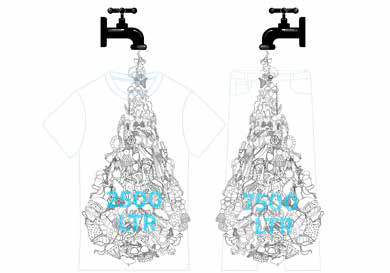
“Multiple studies estimate the apparel industry is responsible for between 4.0-8.1% of global carbon emissions.” Pollak, A. 2021, “The Dark Secrets of the Apparel Industry.” Additionally, so much of our discarded clothing is consistently dumped into landfill sites that the impact on local environments and businesses is severe, possibly to an unreturnable state. Only 10% make it into thrift or vintage stores for resale. In order to facilitate change for environmental, ethical, and sustainable lifestyles, people need to be empowered to make more conscious decisions.
What does the future of the consumer goods industry hold? Documentaries over the last ten years like the previously mentioned The True Cost were plentiful, but have they made waves in changing our perceptions of what constitutes ethical and sustainable fashion? Do well-known campaigners like Stella McCartney, or brands like People Tree, change the public’s opinion and their approach to how often we purchase and why? Is there a growing shift in our consciousness, summed up by fashion designer Dame Vivienne Westwood, who stated, “Buy Less, Choose Well?”
The thing about human beings is that we want to strive for more—better jobs, better clothes, better diets, better health, and better lives. We are impatient and we want everything now. However, the COVID-19 pandemic has remodeled how many people see their lives, from work-life balances to product consumption. Has it also changed fast fashion?
There is an increase in the number of people who are adopting to thrift for most of their clothing, mend and upcycle, or make more discerning choices on the quality of what they buy, and how often. Yet it is disheartening to see that there are new waves of people using social media platforms to show off their “shopping hauls.” The variation in these, however, ranges from the higher level “look what I purchased from Balenciaga,” to more worrying and potentially influential content from some social media creators who proudly show off their mass market, fast fashion swag for vastly reduced prices.
The outreach and direct influence of these is unclear, given the ever-evolving nature of social media platforms and their growing popularity. Nevertheless, they are possibly encouraging a new generation of spenders to consider more and more consumption of cheaply acquired, easily accessed and disposed of clothing—which only contributes to the wider issues around fast fashion—while gaining more followers, likes, and fame in the process. How do we empower change? How do we address issues pertaining to the insurmountable monster that is fast fashion? Perhaps, as mentioned previously, the societal shift in our consciousness following analysis of ourselves, pre and post-pandemic, may have a long-lasting effect on how we live our lives.
Perhaps we need to address the nature of design itself, through the next generation of green-thinking, creative students who graduate and enter the fashion industry. Most, if not all, design colleges and universities have embedded sustainable, inclusive, and ethical elements into their curriculum. Design doesn’t just have to be pretty, but also embrace new technologies and new ways of creation, along with considerations to life cycles, purpose, and usage.
“Design schools are educating students about how fast fashion is the result of power and dominance from white supremacy and capitalism. By providing students with critical histories and frameworks from which to think about fast fashion, students can better understand how the current system has been created and is reinforced, and how they can intervene and unsettle it through their design practices. Design education can transform current thinking and practices because it shapes the world views and processes of the next generation of makers and designers.”
— Dr. Ben Barry, PhD (2022) Dean of the School of Fashion, Parsons, The New School.
Fast fashion brands are quickly adopting new sustainable practices within their product offerings and business models. Perhaps it is due to more eye-opening data and information available to the public, through an abundance of documentaries on the realities of the industry, versus the good that some brands and spokespeople are doing. H&M’s Reclaimed Denim and Bottle2Fashion Collaboration collections, with their transparent approach to setting goals for water usage and recycling, show a move away from a wholly consumer-led fast fashion angle. Levi’s, which had already firmly established these approaches to sustainability, is expanding on and continuing to contribute to more environmentally conscious design strategies.
Greater numbers of people now thrift their outfits in consignment stores such as Beacon’s Closet, or through luxury resale businesses like The RealReal. The idea of renting garments, rather than purchasing, is also contributing to how people access, use, and re-share clothing, creating a longer life cycle.
There is growing societal awareness of sustainably-driven brands such as Eden, People Tree, and Patagonia (to name but a few) whose “slow fashion” business approaches have helped pave the way for more companies to adopt similar policies. As a society, our behaviors and attitudes about what we purchase, when, how, and from where, are generally shifting.
The COVID-19 pandemic created a rift from our previous lives, making us look at what is truly important to us. The ripple effect of 2020 is still ongoing in how we live and behave in terms of what we buy. Will the current iteration of fast fashion ever disappear, or will it evolve along with the global community? Will companies be held accountable, and if so, how? Perhaps societal insistence on greater transparency with mass market fashion brands and their day-to-day business practices will initiate change. A larger shift in our consumption habits could aid this evolution. Perhaps it is up to us.
About the Writer
James Hamilton Butler is currently Director of both AAS Fashion Design, and AAS Fashion Marketing & Communications Programs, at Parsons, School of Fashion, The New School. Prior to Parsons, he worked in education for many years at UAL at The London College of Fashion where he focused on apparel product development with business and marketing.
Butler has worked on various special outreach community projects, including performance & collaboration at London’s Barbican Centre. Alongside his academic career, he has extensive professional experience in a variety of creative and art directive roles with a number of global companies as well as having produced his own fashion brand and collaborations in womenswear and menswear markets, showing at London and Tokyo fashion weeks as well as various solo multimedia exhibitions of his work.